
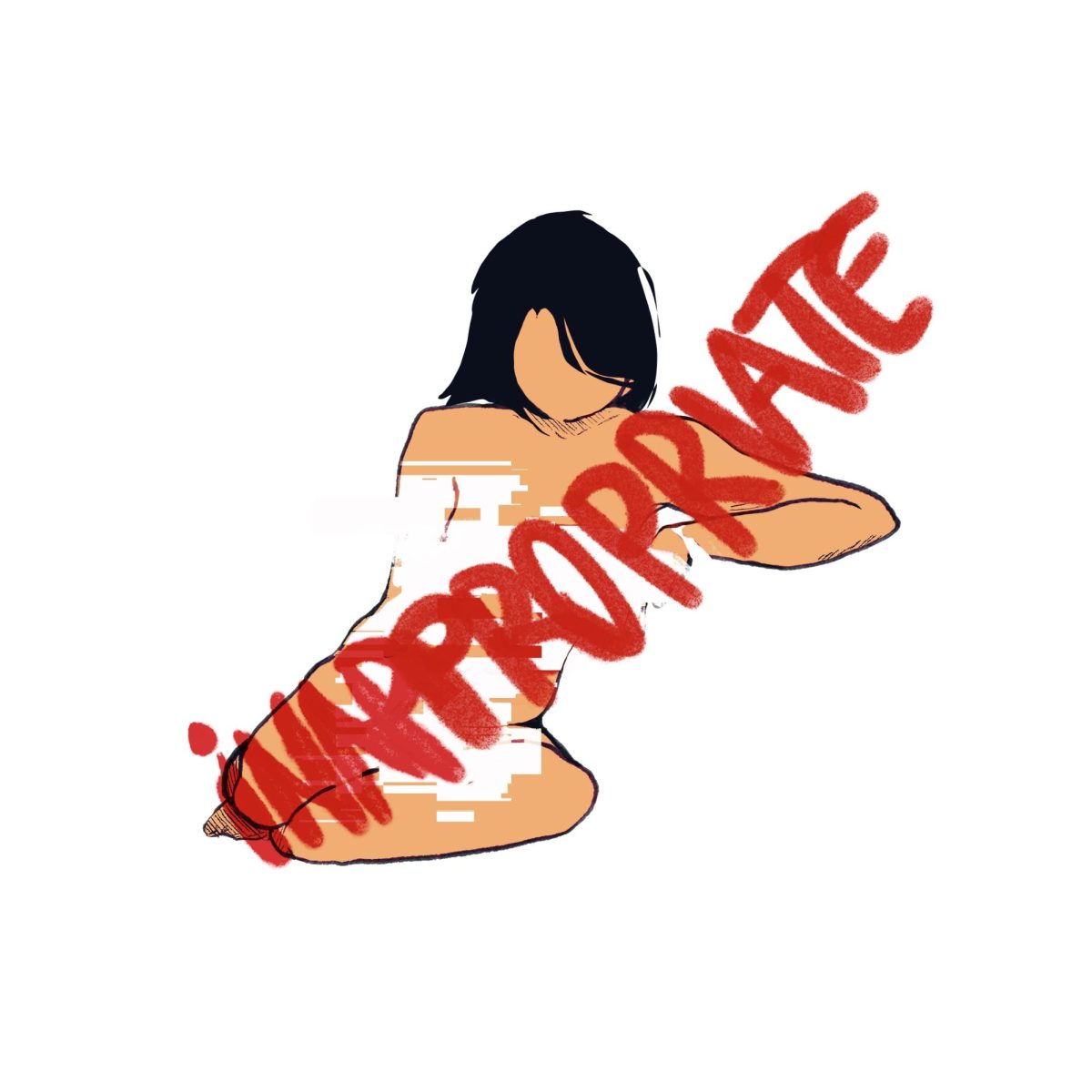
Many art teachers and high school administrators grant their students the freedom to be creative and expressive in their art or writing. Oftentimes, it’s common that the more artistically inclined students tend to push the boundaries of these freedoms, with the sole intention of creating something beautiful. But is something that pushes boundaries, for example, art with revealing body parts, or writing with harsh language, appropriate for the high school level? At what point should there be a line drawn? When do those freedoms infringe on the school’s terms and conditions? In school, a student’s expression, whether speech, art, writing, or other forms, is not acceptable when it becomes too mature for the high school level of learning.
Art Teacher Gimi McCarthy, who teaches the senior ceramics class, likes to give his students the freedom to express themselves however they see fit. McCarthy does, however, understand there are some limitations. He said, “Everybody is going to feel like they have the right to do it.” He further describes the effects of the freedom some students have had. McCarthy said, “I had a problem a couple of years ago with a bunch of boys making these inappropriate body parts, and at some point they put them on another teacher’s desk.” While some students may create nude art from an artistic perspective, others will exploit this freedom with the intention of being humorous.
In perspective, the human body is often featured in art. In many museums, the naked human body can be found in paintings, or in architecture, as it’s seen as artistic. Artist and Senior Nova Mildh also includes some forms of the human body in her artwork. She was recently asked by administrators at UC High to alter her art project because it contained portions of revealed body parts. Mildh said, “I didn’t see anything wrong with it…. I was more confused about what the problem was. There were no intentions other than to make art.” She stressed that her artwork reflected her artistic maturity and was not made with inappropriate intentions. However, regardless of the intentions of the student’s art, the piece was still seen as too revealing of the woman’s body and, therefore, was understandably deemed inappropriate for the high school environment.
Just because portraying human body parts in the nude isn’t acceptable in high school, that doesn’t mean this type of artwork isn’t appropriate in higher levels of education. There are art courses in college that include nude models for students to study for classwork. From the UC High directory, someone who has personally majored in art during college years, School Therapist Doctor Laura Alles, said, “If something similar were done on a college campus, it would not have been second-guessed.” She is pointing out that this type of artwork is not “bad,” it’s just a more mature form of art and not necessarily high school appropriate. Regardless, she thinks students should express themselves however they see fit. According to Alles, “I would absolutely encourage students to continue all kinds of art.” Expanding more on the appropriateness, she clarified, “The only place they should censor themselves is when and where.” This highlights that students should still express themselves, but with a more conscious thought on the location and time, and considering why some things are not acceptable in high school.
While some would suggest that most high school students should be mature enough to handle artistic expression, this isn’t always the case. While Mildh’s art is undoubtedly created from a place of thought and creativity, the reality of high school is that many students are not able to handle such creative freedom. McCarthy’s story from years prior illustrates just how expanded freedoms can be exploited by immature students. Although both students and staff agree there is nothing inherently wrong with a widened scope of expression, time and place must be considered when creating mature art.