
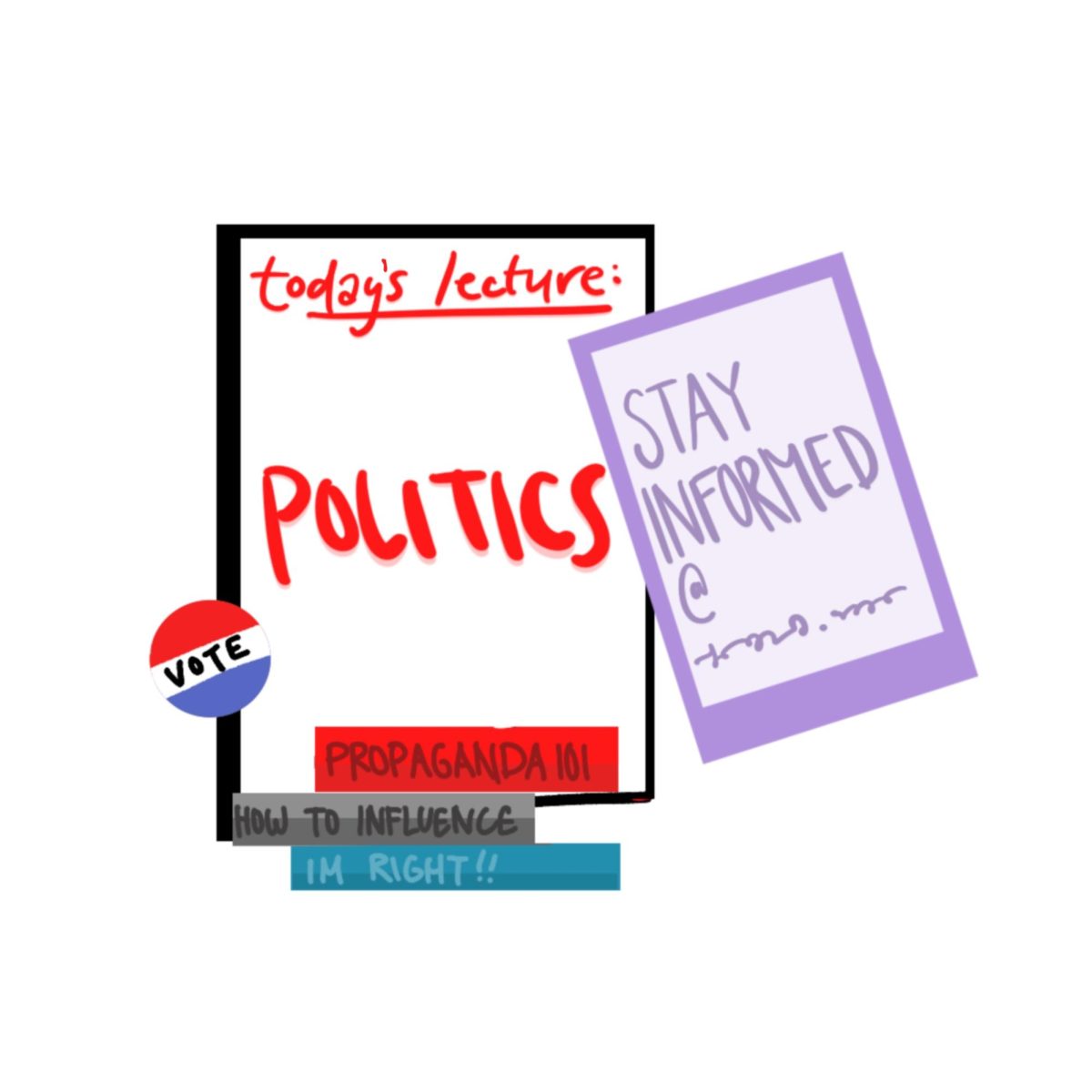
In the polarized America of today, it seems there are few spaces where political neutrality is strived for or celebrated. In fact, the opposite is true; people continue to cheer as they see their favorite, formerly publicly impartial artists or content creators take a political stance. Schools, however, should not follow this trend. As institutions of fact-based learning, schools should strive for political neutrality, presenting data about the world and allowing students to draw their own conclusions.
According to American Enterprise Institute Writer Samuel Abrams, “The purpose of a teacher is not to produce replicas of their own political commitments; it’s to cultivate curiosity, reasoning, and judgment so students can form commitments of their own” (aei.org). Indeed, the idea that the main goal of schools is to produce critical thinkers is nothing new, but important nonetheless. Allowing political opinion to be presented alongside or as fact, however, prevents schools from achieving this goal. When teachers introduce political beliefs alongside facts or teach in an obviously biased manner, students, who are used to learning generally neutral material, treat these political beliefs as fact and adopt them in the thinking that they are the objectively correct ones to have. Critically thinking about a topic thus becomes more difficult for students, and the school ends up hampering its own goal.
In addition to preventing critical thinking, political bias in schools and teachers also creates a less welcoming and less intellectually diverse environment. When specific viewpoints are endorsed by schools or teachers, while others are shunned, it causes students with those other beliefs to feel like they belong less, and thus will be less likely to share their viewpoints. Teachers or schools that are actively partisan could also lead to students receiving an education rife with the cherry-picking of topics or facts that focus only on things that support the school or teacher’s political biases. Ultimately, when schools or teachers take specific political stances, students suffer, as the classroom is more rigid and students are exposed to fewer perspectives.
The phrase “Everything is political” is one that is heard often nowadays, and it is true. Everything is intertwined with politics in some way or another. However, just because everything is political does not mean it has to be super partisan. A good example for schools to follow in how they approach political topics would be that of how they already approach scientific topics. Most people could probably agree that math and science are taught and thought of in a pretty neutral way in school, as those classes really only focus on objective facts that are supported by the scientific community and real-world application.
Facts are simply presented, and thus partisanship is almost completely avoided. Schools and teachers should thus model their approaches to political topics in a similar fashion. All of the facts, or at least a reasonable amount, should be given to students, and then they should be free to formulate their own stance. When it comes to issues that are broadly controversial, schools and teachers should still discuss them, but only give weight to the objective facts surrounding them, and avoid making public, opinionated statements. While it’s impossible to be completely, totally neutral, taking this approach would go pretty far, and for the most part, be good enough.
Schools and teachers are in a tough position; it’s hard to remain objective and neutral when approaching political topics. For the sake of students, however, it is important that they do their best to remain as impartial and informative as possible.